

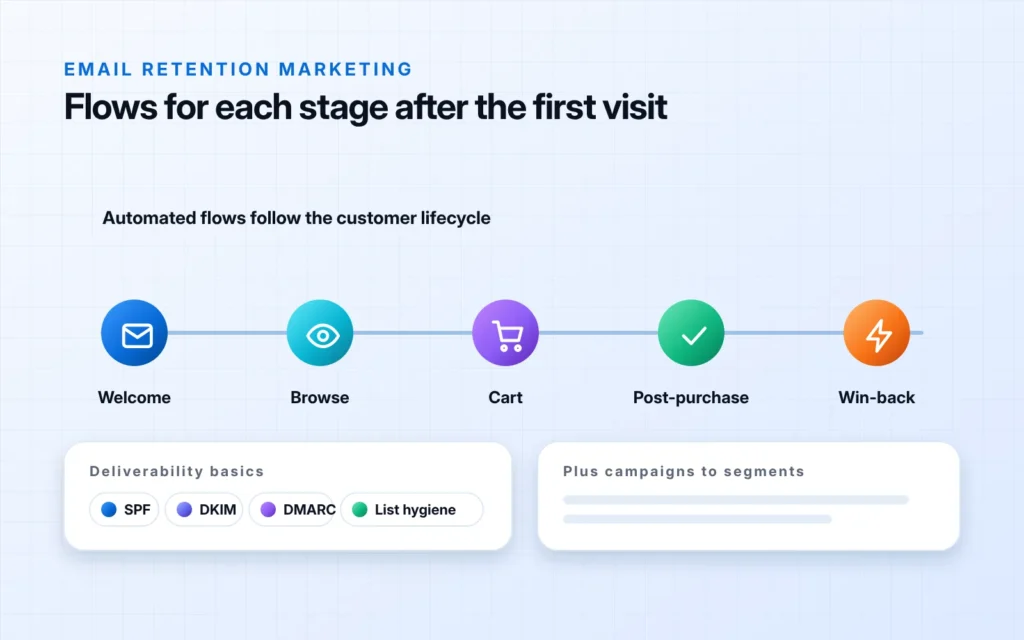
What is email retention marketing?
E-commerce email retention marketing uses automated flows and targeted campaigns to keep customers buying after their first order. Flows react to behaviour, such as signing up, abandoning a cart, buying or going quiet, while campaigns share launches, offers and stories with segmented lists.
Because flows run automatically and reach people who already know you, they often produce a large share of a store's email revenue. Good programmes also protect deliverability with authentication, list hygiene and sensible sending frequency.
At a glance
- Best forOnline stores with steady traffic and repeat potential
- First resultsOften within the first months, as flows collect data
- Main deliverableCore flows, campaign calendar and sign-up forms
- PlatformsKlaviyo, Shopify Email, Mailchimp and Omnisend
How our email retention
process works.
- 01
Audit
Platform, list, flows and deliverability.
- 02
Foundation
Authentication, forms and segments.
- 03
Flows
Welcome, cart, post-purchase and win-back.
- 04
Campaigns
Monthly campaign calendar and designs.
- 05
Test
Tests on timing, content and offers.
Five flows every
store should consider.
Welcome
Introduces the brand to new subscribers and gives them a reason to make a first purchase.
Browse and cart
Reminds visitors about products they viewed or added, without pressure.
Post-purchase
Confirms, educates, asks for a review and suggests what to buy next.
Win-back
Reaches customers who have gone quiet, with timing based on your normal reorder cycle.
Emails people
want and can receive.
Retention email depends on permission. We only email people who have opted in, honour unsubscribes, and set sign-up forms to explain what subscribers will get. Rules on consent and marketing messages differ between countries, and we do not give legal advice, so we ask you to confirm local requirements.
On the technical side, mailbox providers expect sending domains to be authenticated. We set up SPF, DKIM and DMARC records, clean the list of inactive addresses and ramp up sending carefully. Our own approach to nurturing leads for service and B2B businesses is described separately under Email Marketing, because the goals, flows and metrics differ from store retention.
Send fewer emails,
each one more relevant.
Segmentation means sending different messages to different groups: first-time buyers, repeat buyers, people who bought a certain product category, customers who have not ordered for a while. Even simple segments usually outperform sending every email to the whole list, and they reduce unsubscribes.
We report revenue from flows and campaigns separately, along with open and click trends, list growth, unsubscribe and complaint rates. Open rates are less reliable than they used to be because of mail privacy features, so we weigh clicks and revenue more heavily, and we test one change at a time so results can be understood.
Your email retention plan, fully covered.
- Email platform audit
- Domain authentication set-up
- Sign-up forms and pop-ups
- Welcome series
- Abandoned cart and browse flows
- Post-purchase and review flows
- Win-back flows
- Segmented campaigns
- Monthly email revenue report
Tools we use
Email Retention Marketing
questions.
At minimum: welcome, abandoned cart, browse abandonment, post-purchase and win-back. These usually produce the most automated revenue.
Klaviyo is a strong choice for many Shopify and WooCommerce stores. Shopify Email suits smaller stores. We recommend based on your size and needs.
Many stores do well with one to three campaigns per week to engaged segments, with lower frequency for less engaged subscribers. We test and adjust.
This service focuses on online store revenue, product flows and repeat purchases. Our CRM email marketing service focuses on lead nurturing and newsletters for service and B2B businesses.
Yes. We can add SMS or WhatsApp messages to flows where they are allowed and customers have opted in.
Email retention covers the automated flows and campaigns. Customer Retention Optimization looks at the wider system, including loyalty, subscriptions, offers and experience.
Free email flow audit