

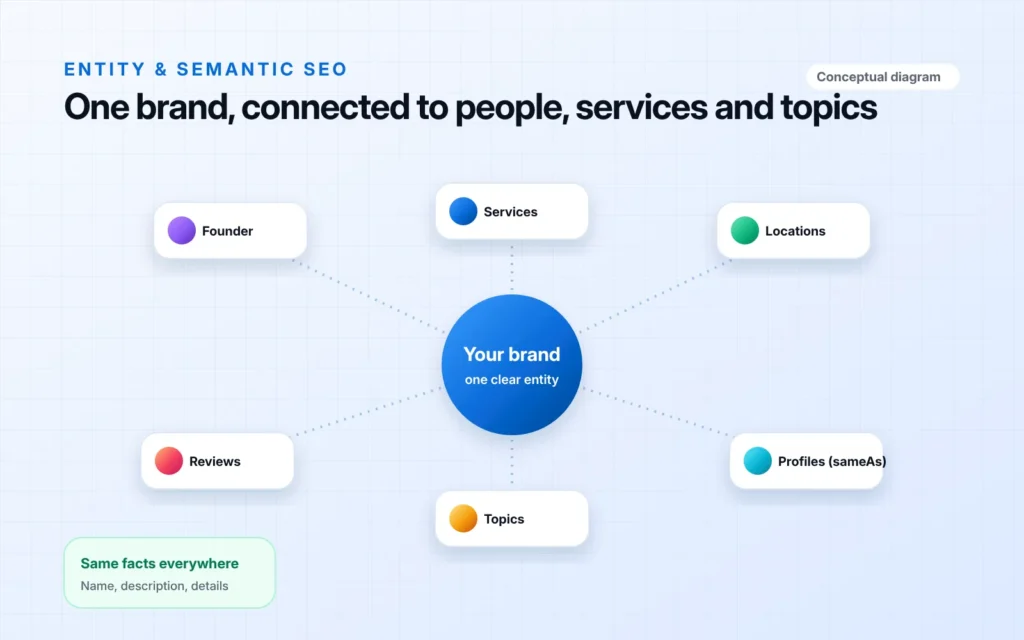
What is entity and semantic SEO?
An entity is a clearly defined thing, such as your company, its founder or a service, that search engines can identify and connect to other things. Entity SEO makes sure those connections are accurate and consistent across your website, structured data and trusted profiles.
Semantic SEO builds topical depth around your entity by covering related concepts, questions and subtopics, so search engines see your site as a complete source. Together they help search engines understand you, can support a knowledge panel where Google chooses to show one, help you rank for broader topics and reduce errors when AI tools describe you.
At a glance
- Best forBrands with inconsistent profiles or no knowledge panel
- First signalsOften months, and never guaranteed
- Main deliverableEntity map, schema graph and topical coverage plan
- SupportsSEO, AI Overviews, GEO and brand search
Who you are comes
before who is recommended.
Entity work answers a precise question: can machines tell exactly who you are? It is a foundation for other work in the AI Search Optimization programme. GEO (Generative Engine Optimization) goes further, covering comparison content, reviews and mentions that influence whether a brand is recommended, and tracking what AI tools say.
Consistent facts
We write a brand fact sheet: legal and trading name, description, services, locations, contact details, founding date, people and official profiles. Then we make the website and key profiles agree with it.
Connected structured data
Organization, Person, Service and sameAs markup describe how the pieces relate. The markup must match what visitors can see, and it supports understanding without guaranteeing any result.
Topical depth
A topic map shows which concepts and questions your site should cover and how pages should link, a method that complements SEO Content Strategy.
How our entity SEO
process works.
- 01
Audit
How search engines and AI tools see your brand today.
- 02
Map
Brand, people, services and topics mapped.
- 03
Mark up
Connected structured data implemented.
- 04
Align
Profiles aligned and trusted mentions built.
- 05
Deepen
Content added to complete your core topics.
Markup that describes
the real world.
Organization
Name, logo, contact details and official profile links for the business.
Person
Founders and authors, with roles and links to their profiles, where they agree to be named.
Service
What you offer and where, matching the visible service pages.
sameAs
Links from your site to your official profiles, which help connect the same entity across the web.
What entity work
cannot promise.
Google decides whether to show a knowledge panel and what it contains. AI tools decide what to say. We cannot promise either. Schema markup alone does not guarantee a rich result, a panel or a citation, and incorrect or exaggerated markup can cause problems.
What we can do is remove ambiguity, correct inconsistencies and give search engines clear, verifiable facts. Local businesses should also keep their profiles accurate, as covered in Google Business Profile Optimization.
Your entity SEO plan, fully covered.
- Entity and knowledge panel audit
- Brand fact sheet
- Organization and Person schema
- Service and sameAs markup
- Profile alignment across key platforms
- Author and expert entity set-up
- Semantic topic map
- Contextual internal linking plan
- Entity progress report
Tools we use
Entity & Semantic SEO
questions.
Entity SEO makes your business, people and services clearly identifiable to search engines and AI tools through consistent information, structured data and trusted profiles.
Semantic SEO builds content around the full meaning of a topic, including related concepts and questions, instead of single keywords. It helps search engines see your site as a complete source.
Google decides when to show a knowledge panel, so it cannot be guaranteed. We strengthen the signals Google can use, such as consistent facts, structured data and trusted mentions, which can improve the chances.
AI tools can only describe a brand as accurately as the information they can find. Consistent facts reduce errors and make it easier to connect your brand with the services you offer, though no outcome is guaranteed.
No. Schema helps, but it needs to match consistent information across your site, profiles and third-party sources. We treat it as one part of a complete entity strategy.
Entity work makes sure machines can identify exactly who you are. GEO also covers comparison content, reviews, mentions and tracking of what AI tools actually say.
Free entity review