

Why every platform
reports a win.
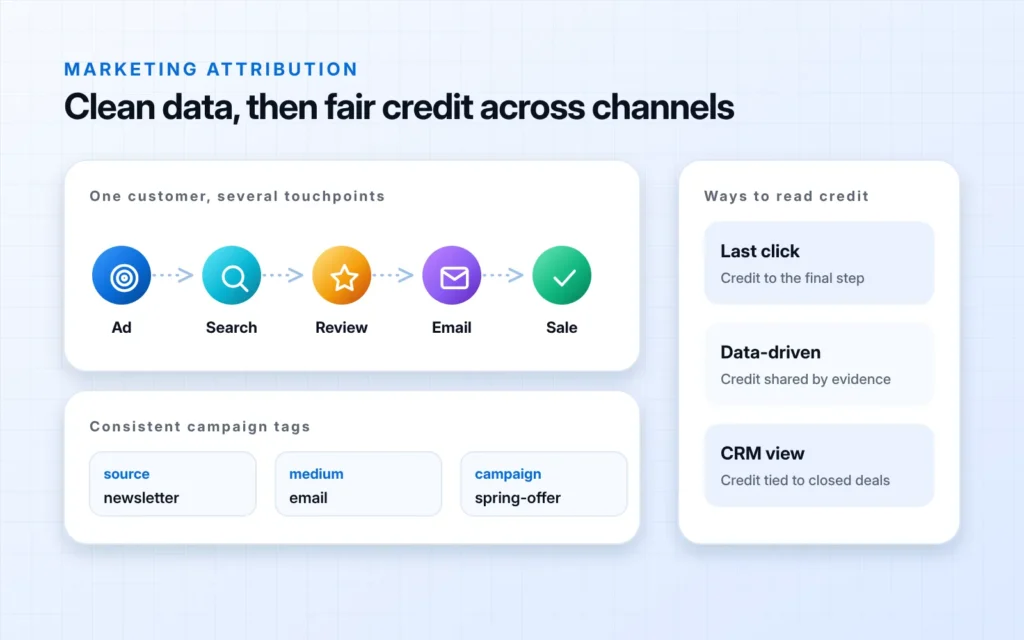
A buyer rarely follows a straight line. They might see an ad, search for the brand days later, read a review and finally return through an email before buying. Each platform sees only its own touchpoint, applies its own rules and reports the conversion as its own. Add them together and you can account for more sales than you actually made.
Attribution is the discipline of assigning credit across those touchpoints in a consistent way. No method is perfect, so the goal is not a single true number. The goal is a view that is consistent enough to compare channels and good enough to move budget with confidence.
What is marketing attribution?
Marketing attribution assigns credit for conversions to the channels and touchpoints that influenced them. It builds on clean tagging, accurate conversion tracking and a connection to real sales in your CRM.
From that base, GA4 data-driven attribution, platform reports and simple modelling give a clearer view of which channels to grow and which to question. We use the models available in your tools and explain their limits.
At a glance
- Best forBusinesses spending across several marketing channels
- Setup timeUsually three to six weeks
- Main deliverableCampaign tagging system, CRM link and attribution reports
- ApproachGA4, platform data, CRM matching and simple modelling
How our attribution
process works.
- 01
Audit
Tracking, UTMs and CRM fields reviewed.
- 02
Define
UTM rules and channel groups defined.
- 03
Connect
Lead sources stored and synced to the CRM.
- 04
Report
Attribution views and ROI reports built.
- 05
Advise
Budget recommendations reviewed monthly.
Three views,
used together.
Last click
Gives all credit to the final touchpoint. Simple and useful for closing channels, but it undervalues awareness.
- Easy to explain
- Biased toward the end of the journey
Data-driven
GA4's data-driven model distributes credit based on observed paths, when there is enough data to support it.
- Needs sufficient conversions
- Best as a default view
CRM view
Ties lead source to closed deals and revenue, which is slower but closest to business results.
- Needs source fields in the CRM
- Best for long sales cycles
UTM tags are the
foundation.
UTM parameters are labels added to links, such as source, medium and campaign, that tell analytics where a visit came from. When they are missing or inconsistent, traffic falls into direct or unassigned and no model can rescue the report.
A naming convention
We agree lowercase, consistent values, a short list of allowed mediums and a pattern for campaign names, and document it in one page the whole team can follow.
A link builder
A shared sheet or form that generates tagged links removes typing errors and keeps new campaigns consistent.
Carrying source into the CRM
Source and campaign values are stored on the lead when it is created, so a closed deal can be traced back. This relies on the tracking described under Conversion Tracking.
Your attribution plan, fully covered.
- Attribution data audit
- UTM naming convention
- UTM link builder
- Custom channel grouping in GA4
- CRM source and campaign fields
- Offline conversion matching
- Data-driven attribution reports
- Channel ROI dashboard
- Monthly budget recommendations
Tools we use
Marketing Attribution
questions.
Marketing attribution assigns credit for conversions to the channels and touchpoints that influenced them, so you can understand which marketing activities contribute to results.
No model is perfect. GA4 data-driven attribution is a good default where there is enough data, and we compare it with platform data and CRM results to make balanced decisions.
Untagged links, some apps and email clients, and tracking gaps often appear as direct traffic. Consistent tagging and tracking fixes usually reduce it, though some will always remain.
Yes. By storing source data in your CRM and matching it to closed deals, we connect marketing channels to actual revenue.
Not to start. GA4, BigQuery, your CRM and Looker Studio cover most needs. Dedicated tools make sense only when the scale justifies them.
No. It informs the decision. Awareness channels in particular are hard to measure, so we pair the numbers with tests, such as pausing or varying spend in a channel, before recommending big changes.
Free attribution review